
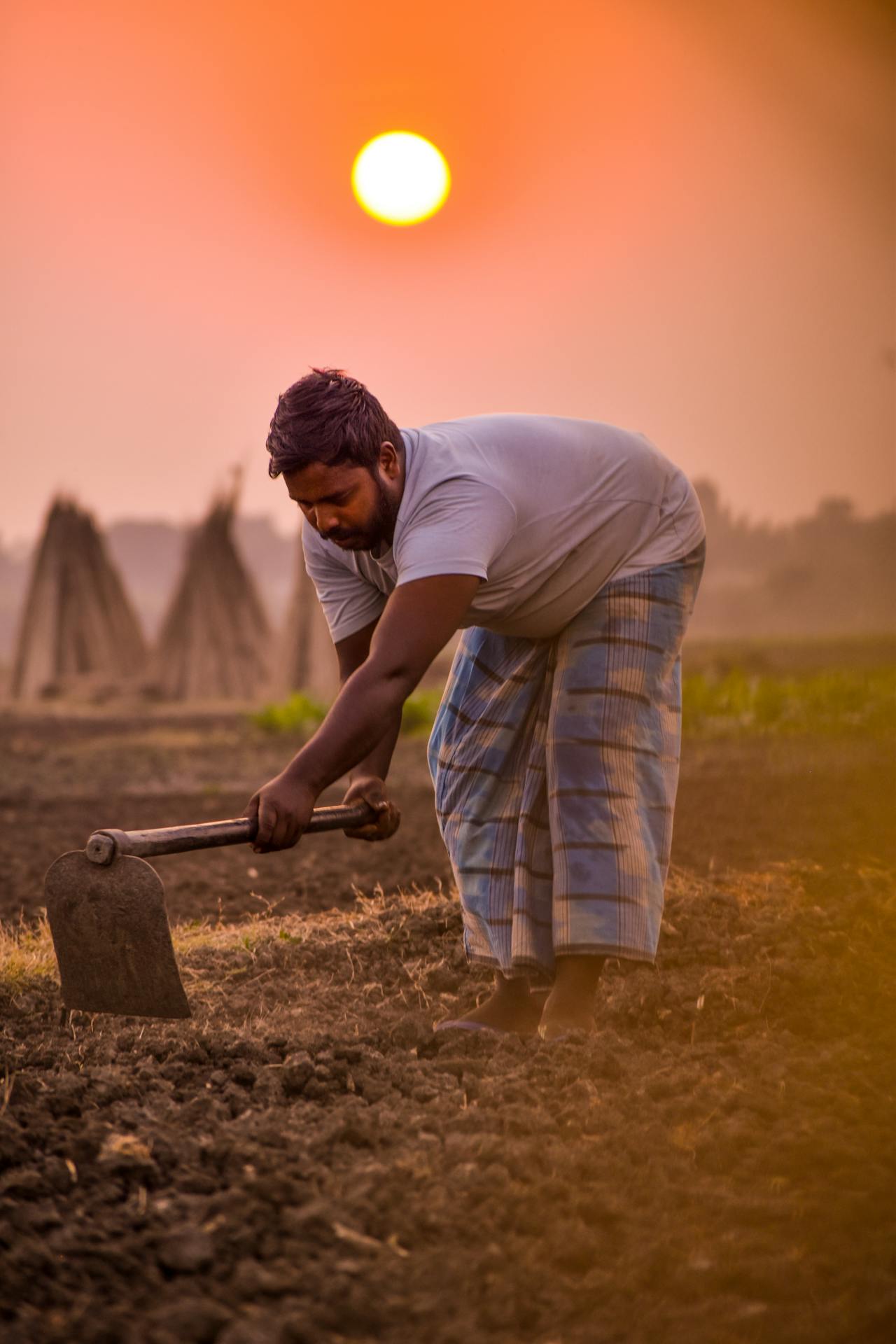
In agriculture, there are four – what economists would call – “factors of production”: Land, water, labour and energy. Farmers use these factors or inputs to produce crops. For a given level of technology, the output produced by them is largely determined by the quantity of inputs used.
In the pre-Green Revolution era, agricultural production was primarily limited by the extent and quality of land available for cultivation. India’s farm sector, according to a NITI Aayog paper by Ramesh Chand and Jaspal Singh, grew by an average 2.8% a year during 1950-51 to 1961-62. The driver was expansion in the land brought under the plough. The country’s net sown area rose from 118.75 lakh to 135.40 lakh hectares (lh) over this period.
 Trend of annual growth rate in agriculture.Agricultural land quality is a function of soil fertility and water availability. The alluvial soils in the Indo-Gangetic plains and the Kaveri, Krishna, Godavari and Mahanadi deltas of the eastern coast are the most fertile, followed by the black cotton soils of the Deccan, Malwa and Saurashtra plateaus. These yield more crop per acre than the lands with red, brown, laterite, mountain and desert soils, ranking in descending order of fertility.
Water availability is dependent on both rainfall and access to irrigation from rivers, lakes, tanks and ponds. The great ancient civilisations came up mostly in river valleys that could sustain vibrant agriculture.
As regards labour and energy, in traditional agriculture, the more the farm hands and bullocks there were to work the land, the more the produce that was harvested. Before the arrival of tractors, threshers, harvester combines and electric/diesel engine-driven tubewells, the main energy source in farms were bullocks. They ploughed the fields, and also treaded the crops to separate the grain from chaff and powered the Persian wheels to draw water from wells for irrigation.

Factors of technology
Just as the four “factors of production”, there are four, what one may term, “factors of technology” in agriculture. The factors of technology enable more efficient use of the factors of production. They result in higher yields – more produce from the same acre of land or number of labourers – besides better utilisation of water resources and replacement of animal and human power with mechanical and electrical power.
The four “factors of technology” are genetics, crop nutrition, crop protection and agronomic interventions.
Genetics is about seeds and plant breeding. There would have been no Green Revolution without the high-yielding wheat and rice varieties that Norman Borlaug, Henry Beachell, Gurdev Singh Khush and other scientists bred. These varieties incorporated dwarfing genes that reduced the height of the plants.
Traditional varieties, having tall and slender plants, didn’t respond much to fertiliser or water application. When their ear-heads were heavy with well-filled grains, they bent over or fell flat on the ground. The new semi-dwarf varieties had strong stems that held the grain-bearing panicles upright even when heavily fertilised, enabling them to absorb more nutrients and convert these to grain.
Just as with reduced height/semi-dwarfing, there are genes in plants that code for proteins (enzymes) responsible for disease and pest resistance, drought and heat stress tolerance, nutrient use efficiency or even stem sturdiness and erect/compact canopy to allow mechanical harvesting. The genetic information for all these desirable traits is contained in the seeds of the plant varieties/hybrids developed through crossbreeding and agricultural biotechnology tools.
Farmers traditionally reared cattle for not just draught power and milk, but also their excreta that provided the nutrients necessary for plant growth. Farmyard manure – the decomposed mixture of dung and urine along with other farm residues – contains 0.5% nitrogen (N), 0.2% phosphorous (P) and 0.5% potassium (K) on an average.
The revolution in crop nutrition happened with chemical fertilisers having much higher NPK content: Urea (46% N), di-ammonium phosphate (18% N and 46% P) and muriate of potash (60% K). Synthetic fertilisers, in combination with the breeding of varieties responsive to high nutrient doses, led to a soaring of crop yields. Farmers also saved on labour in maintaining animals and collecting, storing and composting their manure; the fertilisers came from factories in bagged ready-to-use form.
With higher yields also came technologies for crop protection – defending plants against insect pests, pathogens (fungi, bacteria and viruses) and weeds, from the time of their sowing to harvesting and marketing. Crop protection chemicals are aimed at ensuring that the yield gains from genetics/breeding and nutrition/fertilisers are realised, to the maximum possible extent, in farmers’ fields. Some are labour-saving as well. Herbicides, for instance, can replace the manual removal of weeds.
The last factor of technology is mechanisation and other agronomic interventions. Tractors, apart from rendering bullocks redundant, have made it possible to use implements such as rotavators and reversible mould board ploughs that can do deep tillage, mixing and pulverisation of the soils and break their hardpan layers.
Agronomic interventions also extend to water-saving technologies – drip irrigation and laser land levelers (which help in uniform placement of seed and fertiliser too) – and intercropping or growing more than one crop simultaneously on the same piece of land. There are farmers today cultivating pomegranates in Rajasthan’s arid desert soils through drip irrigation and water-soluble/liquid fertilisers. There are similarly those using tractor-drawn machines to make raised beds in fields. They plant sugarcane on the furrows and various short-cycle crops – potato, onion, garlic, vegetables and pulses – on the raised beds.
The next gamechanger – even if their bearing fruit in Indian farms may take time – could be drones for spraying fertilisers and agrochemicals and sensors for real-time monitoring of crop and field conditions.
More from same or less
The factors of technology, to use economics jargon, have “shifted up the aggregate production function” in agriculture. Instead of more output from more inputs (“moving along the production function”), productivity increases have delivered more output from the same or even less level of inputs. In other words, more crop per acre, per farmhand and per drop of water.
The effects can be seen from the net sown area in India rising by just 3.3% – from 135.4 lh to 139.9 lh – between 1961-62 and 2019-20, as against 14% during 1950-51 to 1961-62. The growth in agricultural production over the last 50 years or more has been mainly courtesy the factors of technology.
Chand and Singh have estimated the trend growth rates in gross value added from agriculture and allied activities for different periods, each representing “turning points towards either acceleration or deceleration”. The annual growth during the period from 2005-06 to 2021-22, at 3.7%, has been the highest among all phases (table). That isn’t surprising, considering the faster diffusion of productivity-enhancing technologies and improvement in rural roads, electricity, irrigation and communications infrastructure since this century’s start.
Simply put, the factors of technology have trumped the factors of production.
Credit: Source link

